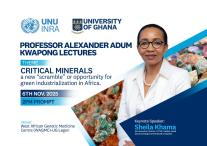


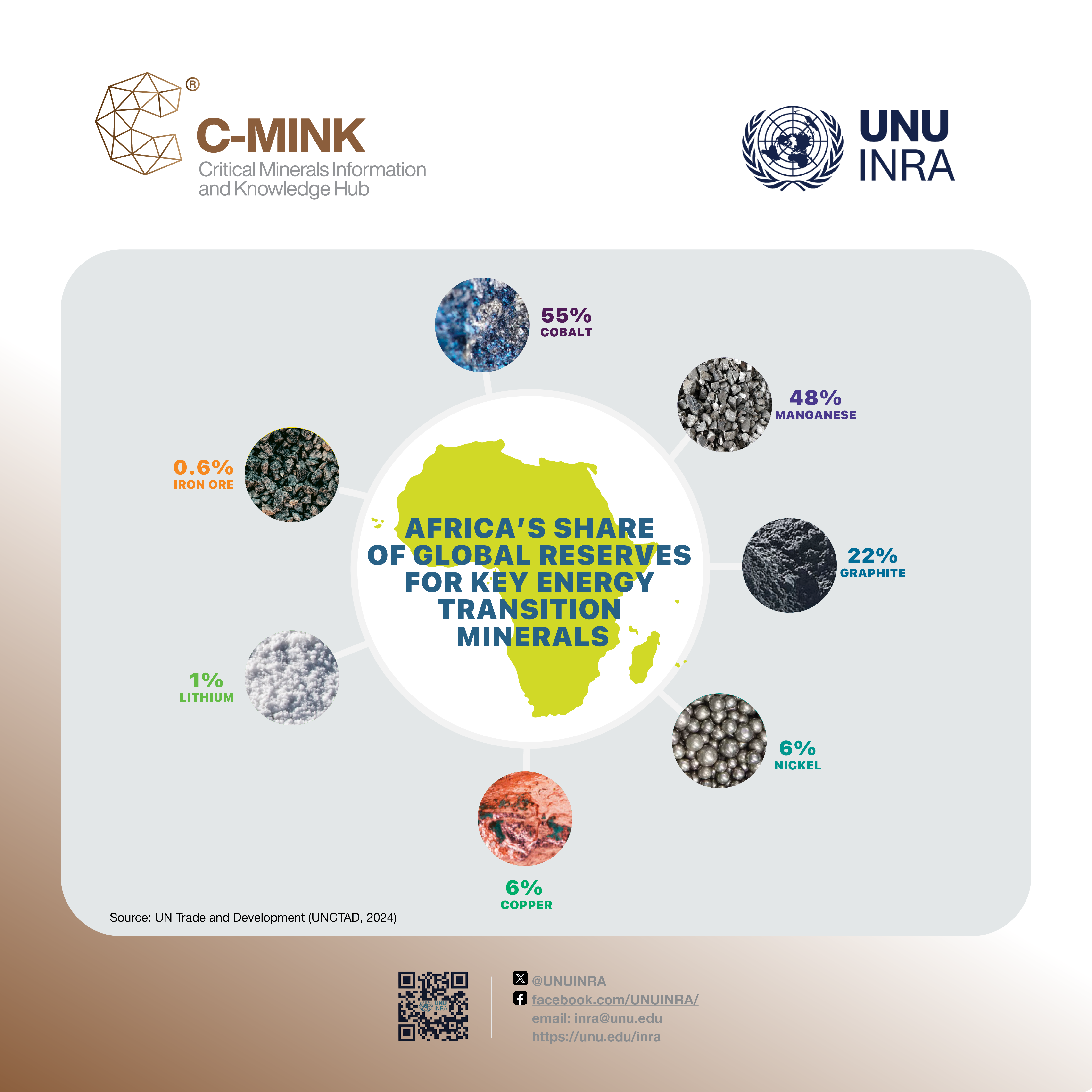
In this new report, UNU- INRA highlights that Africa holds nearly 30% of the world’s critical mineral reserves (cobalt, lithium, manganese, copper, nickel, graphite amongst others). It shows that global revenues from copper, nickel, cobalt, and lithium could reach $16 trillion by 2050, with Sub-Saharan Africa positioned for 10%+ of that value. This report launched at COP30 in Belém, shows that pivotal moment for Africa and the Global South to transform mineral wealth into sovereign power, industrialisation, and shared prosperity.
The report highlights some key challenges in this critical minerals sector including:
The Paradox of extraction: Africa supplies raw minerals but remains excluded from high-value manufacturing (batteries, semiconductors, turbines).
Geopolitical asymmetry: Industrial powers (US, EU, China) dominate mineral security strategies, while Africa risks remaining a supplier of raw ores.
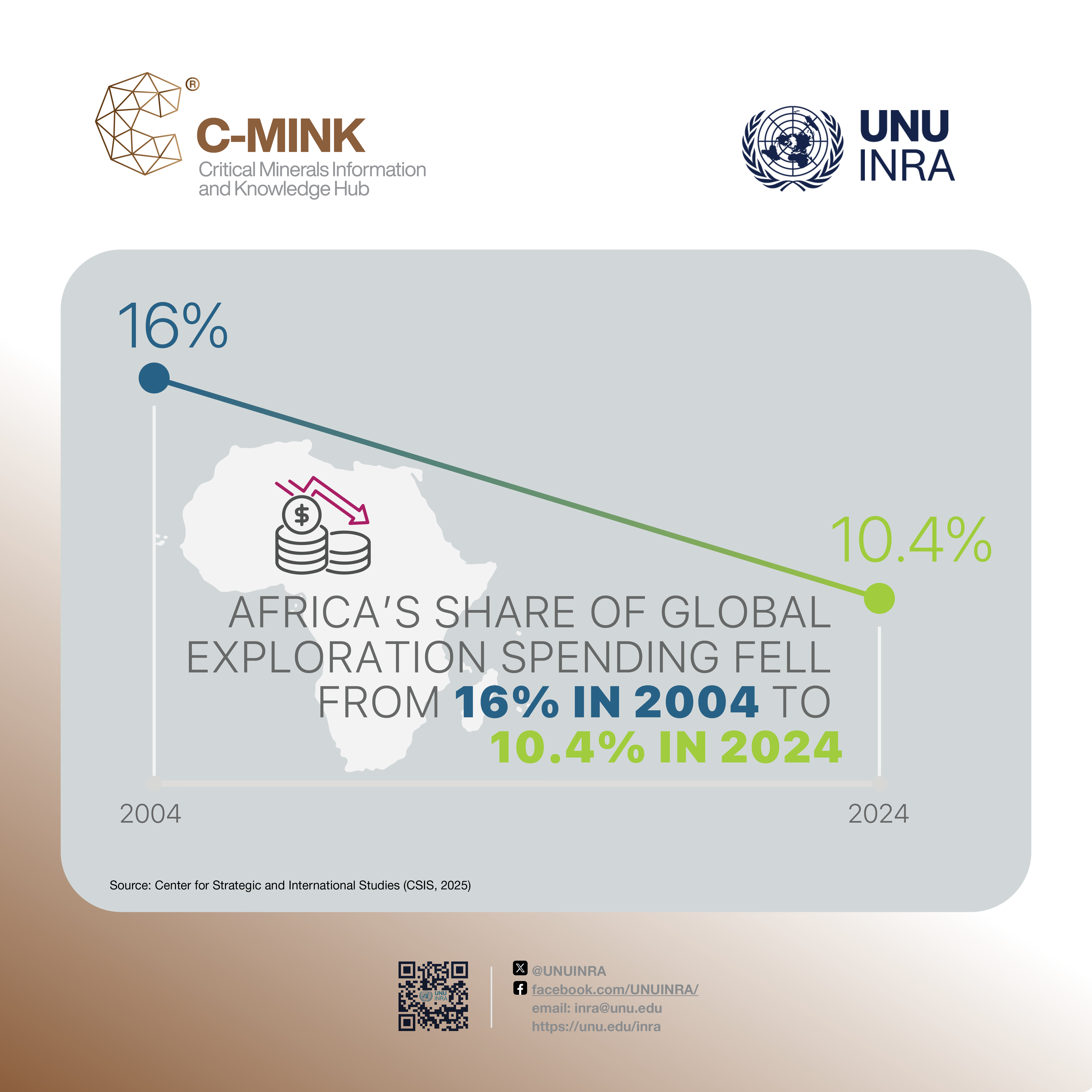
Governance gaps: Weak institutional capacity, fragmented policies, and external investor dominance perpetuate dependency and environmental harm.
It also highlights some significant strategies to explore in this sector including:
- Redefining Criticality for Africa
Move beyond global definitions shaped by industrial powers.
Align mineral wealth with Africa’s own priorities: energy security, industrialisation, food systems, and digital transformation.
Embed minerals into domestic production systems to achieve sovereignty.
- South-South Cooperation
Build alliances with Latin America and Asia to share lessons in resource governance, industrial policy, and ecological sustainability.
Moving towards a Southern Compact for Shared Prosperity that, federates finance, research, and standards.
- Just Transition and Justice-Based Governance
A just transition requires decolonisation of trade and governance: ensuring miners, communities, and nations capture fair value.
Justice must be embedded in trade flows, industrial policies, and social contracts.
Equity measured not by tonnes exported, but by industries and technologies created.
- Institutional and Governance Reform
Establish continental coordination under the African Union.
Strengthen transparency (EITI, digital platforms), accountability, and anti-corruption frameworks.
Develop regional ESG certification systems tailored to African realities.
Invest in foresight units to anticipate market shifts and technological trends.
- Infrastructure and Regional Integration
Transform corridors (e.g., Lobito Corridor) into industrial pathways, linking extraction to refining, manufacturing, and trade.
Harmonize fiscal and industrial policies to build cross-border value chains.
Expand intra-African mineral trade and processing capacity.
The report generally shows that Africa’s mineral wealth is indispensable to the global energy transition and ownership must translate into control, governance, and value creation. By redefining criticality, deepening South-South solidarity, embedding justice, and strengthening governance, Africa can move from the periphery of extraction to the center of transformation.
Suggested citation: New UNU-INRA report on Critical Minerals : UNU-INRA, 2026.