


Introduction
The Western Pacific Region is experiencing some of the world's most severe climate-related health impacts. Communities across the region face escalating, in some cases existential, threats from climate change, including intensifying tropical cyclones, sea-level rise, coastal flooding, extreme heat, droughts, and bushfires. At the same time, these communities are leading important climate solutions, drawing on Indigenous knowledge systems, local expertise, unique geographic strengths, and longstanding traditions of community resilience and mutual support.
Addressing these challenges requires collaboration across communities, governments, health systems, and other sectors that influence health outcomes. Health professionals have a critical role to play in strengthening climate resilience while also reducing the environmental footprint of the health sector itself.
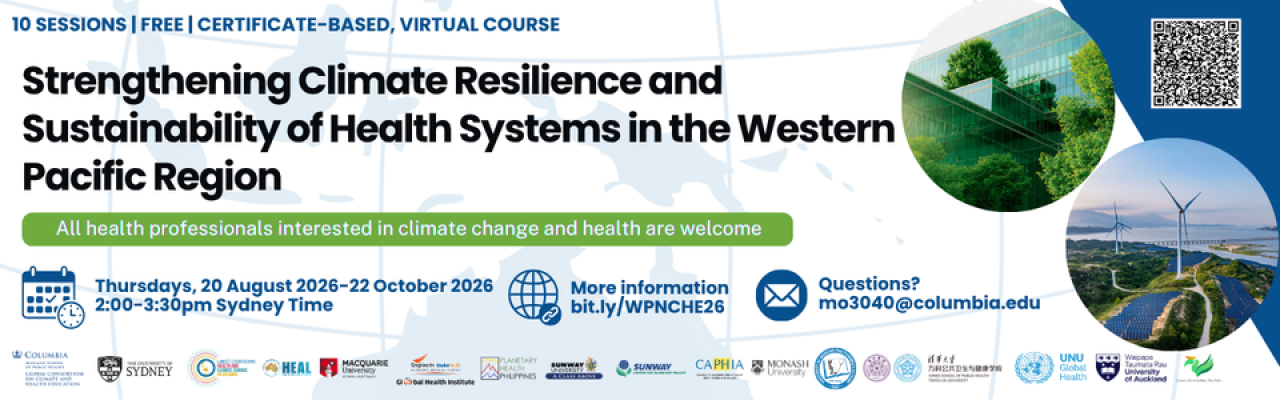
This 10-week course is designed to equip health professionals and health system leaders with the knowledge and practical tools needed to prepare for and respond to the health impacts of climate change. Participants will learn how to assess health system vulnerabilities and adaptation options, measure and monitor climate resilience and environmental sustainability, and implement strategies to reduce emissions and strengthen system preparedness. Throughout the course, emphasis is placed on approaches that are locally grounded, culturally appropriate, economically feasible, and socially equitable.
Course Objectives:
- Articulate/communicate to key partners and the public how uncertain climate futures are likely to have different demands on the healthcare systems and how health systems’ contribution to climate change
- Apply methodology and frameworks for assessing vulnerability and adaptation for health systems in local context
- Apply approaches for measuring and monitoring the environmental sustainability of health systems and health co-benefits of transitioning to green health systems
- Apply a health equity lens into efforts to address health system decarbonization and climate resilience
- Enhance climate and health leadership for action
Course Organizers
The course was developed through a partnership between The Western Pacific Network on Climate and Health Education (WPNCHE), the Global Consortium on Climate and Health Education, University of Sydney; the Lancet Countdown Oceania Regional Centre; Macquarie University; SingHealth Duke-NUS Global Health Institute; Planetary Health Philippines; the Council of Academic Public Health Institutions Australasia (CAPHIA); the Sunway Centre for Planetary Health at Sunway University; the HEAL Global Research Centre at the University of Canberra; the United Nations University; Tsinghua University; the World Health Organization Regional Office for the Western Pacific (including the WHO Asia-Pacific Centre for Environment and Health); the University of Medicine and Pharmacy at Ho Chi Minh City; and Monash University. Through the collective expertise of this partnership, we have designed a course to strengthen health professionals’ capacity to prepare, adapt, and respond to climate-related health threats, while simultaneously reducing the health sector’s own environmental footprint.
Audience
The expected audience includes health systems planners, hospital administrators, health facility board members, long-term care/community care professionals, business continuity officers, emergency responders, sustainability officers, public health practitioners, and health professionals.
Live Course Primary Language: English